There have been some bad decisions over the past decades over humanity’s demand for energy resulting in global warming and the climate change problem. However, many new technologies are advancing replacing the nonrenewable resources that add harmful gases to our atmosphere. The greenhouse effect can easily be reduced and in fact, it is cheaper to fix than to ignore. Many companies are already taking a great leap forward with great increases in their efficiency rates for energy. Using more energy efficient resources has shown great improvements from replacing coal to oil, to lower carbon natural gas, and finally to renewable resources such as wind and solar power. Wind power has shown the greatest improvements so far and is constantly expanding. Denmark is already getting a fifth of its electricity power from wind energy and other countries are contributing in this technology as well. Today much of the carbon released into our atmosphere from the use of nonrenewable resources have been replaced with climate safe hydrogen. Only one third of the atoms released in our atmosphere from energy use are carbon resulting in less pollution. Apart from saving the atmosphere, using less energy has cut down in costs for many smart companies with an estimated savings of over $70 billion per year. Other benefits include eliminating all the social and political costs of getting and burning petroleum, which will decrease military conflict because petroleum will no longer be worth fighting over.
Some people may not realize about the benefits of saving energy and are stuck in the old ways of technology that are not so environmentally friendly. But educating humanity about the environment can help us learn the positive effects of converting to energy efficient technology. Every little bit of saving energy counts. Car companies have lowered the amount of energy used by simply building lighter cars and sustainable buildings have shown decreases in energy use by insulating more. This lowers energy use by lowering the amount of needed heating and air conditioning. This also lowers the costs for building because it eliminates the need to build as much heating and air conditioning technologies. More money is saved and therefore can be used to build more environmentally friendly technologies.
We have come a long way since electricity was invented and it is now commonly taken for granted. Many people rely on the energy for transportation, air conditioning, television, etc. But today we face the danger of running out of the cheap nonrenewable energy sources. Environmental and health burdens fight that we need to head toward a cleaner energy system. Burning fossil fuels is the main cause for air pollution, and water and land degradation. Carbon left in the atmosphere from these fossil fuels has been found partially responsible for some lung cancers and respiratory problems and it is the global environmental effects that really boost the economy towards new safer energy systems. The world economy is constantly looking for new energy sources. An energy source that is socially, economically, and environmentally friendly. Coal, oil, and natural gas are already starting to be replaced by renewable energy sources. Moving away from fossil fuels brings us back to older technologies such as energy from windmills. The high amount of carbon in our atmosphere will be replaced by hydrogen, benign to our environment.
Today the increasing production of automobiles, electronics, software, etc. increases the need for energy dramatically. As more countries are developing the need for a more decentralized energy system is also required. A more decentralized, renewable-resource-based energy system will likely have a better chance of spreading energy services more broadly. More rural employment may be provided with the development of clean and advanced energy services helping out the poorer countries of the world. As more people become aware of the positive effects of a newer and safer energy system, the sooner we can build towards a more sustainable energy system. A new energy system that will meet our energy needs and benefit our natural world.
Climate Change 2007: The Physical Science Basis
Human activities such as the burning of fossil fuels and new agriculture technologies are releasing greenhouse gases into our atmosphere that are contributing to the global climate change. Carbon dioxide the main greenhouse gas mainly released from the burning of fossil fuels has increased faster than ever reaching a global atmospheric concentration of about 379 ppm in 2005. Mainly resulting from agriculture the methane’s atmospheric concentration has reached 1774 ppb which, far exceeds the natural concentration of methane in our atmosphere. Nitrous Oxide has also increased mainly due to agriculture, but has remained relatively constant since 1980.
From 1995-2006, these years has been ranked as having the warmest average temperature ever in the records of global surface temperature. Observations of the effects from climate change include increases in global average air and ocean temperatures, widespread melting of snow and ice, and rising global average sea level. The warmer air can hold more water vapour and therefore the atmospheric water vapour content has increased. More than 80% of the warmer heat added from climate change gets absorbed into the ocean, contributing to sea level rise. The melting of glaciers and snow cover also contributes to sea level rise. Other changes that have been observed include increase in Arctic temperatures, widespread changes in precipitation, extreme wind patterns, heat waves, and intensity of tropical waves. The effects of climate change may vary depending on the location on Earth. For example, observations has shown an increase in precipitation in eastern parts of North and South America and decreases in precipitation near the Mediterranean and southern Africa.
Continued greenhouse gas emissions would continue to show an increasing amount of the aforementioned effects. Even if we began to stabilize the amount of greenhouse gases released into our atmosphere the remaining carbon dioxide in our atmosphere would continue to show effects for centuries. Therefore it will be a slow change into reversing the climate change problem.
At first the meaning conservation came from protecting the forests and land destruction. It now involves all natural resources and beyond. There are three main principles of conservation supporting the use of foresight, prudence, thrift, and intelligence when dealing with public matters. Conservation is using the greatest good to the greatest number for the longest time.
The first principle of conservation involves development. It involves the use of the now existing natural resources existing on Earth for the benefit of the people who live here now. There is only a limited amount of nonrenewable natural resources and we need to only use the amount we need so it can be used for the benefit for future generations as well. The second principle involves for the prevention of waste. As the society realizes more about of the consequences of our waste on Earth and how it is polluting our environment, we are taking more control of our waste and using more caution of where waste is dumped. It is a matter of good business to control waste and it is becoming more possible just like it became possible to control forest fires. The third principle ties in between the last two. It is that the natural resources must be developed and preserved for the benefit of many and not just a few societies. From more developed to less developed countries the use of resources is unequal. We need to become more decentralized and the use of resources should benefit the world as a whole. As we educate society we are becoming more and more aware of the values of the Earth’s natural resources and the importance of it being conserved.
Aldo Leopold describes how he thought of the Earth’s land and how his view had changed after seeing the eyes of a dying wolf. The wolf had a whole other side of meaning than just a mean creature that kills all the deer. The wolf had a purpose, a purpose to control the population of the deer before the deer could harm the mountain it lives upon. If there were no wolves then the deer would take control of all the bush and soon there would be no more bush on the mountain and there would be nothing left for the deer to eat. The deer would soon starve themselves. Before he thought that less wolves meant more deer and afterwards he learned that we are better off having the wolves. Leopold believes that much of humanity’s outlook of the Earth is similar to what his view was before he saw the dying wolf. We take for granted of the land and what lays within and we love our gadgets. He mentions that there is no ethic that deals with man’s relation to land, plants, and animals. It is an ethic that we need to develop, one that gives an outlook of the Earth and the life within as a whole. An ethic would protect the integrity, stability, and beauty of the Earth and give the land value.
Over the last decades technologies has greatly advanced and with it the world’s energy footprint has increased dramatically. Energy is a source of power and the world continues to destruct its landscape to gain it. In China for example, the building of the Three Gorges Damn caused destruction of thirteen full sized cities and relocated 1.2-2 million people. The people themselves were the ones taking apart their homes and cities with dynamite. This shows how much people are willing to go through massive destruction and transformation just to gain power. In Edward Burtynsky’s film ( http://www.ted.com/talks/lang/eng/edward_burtynsky_on_manufactured_landscapes.html ) he talks about how man has really changed the landscape through mines, damns, oil sands, etc. and how we have become disconnected with the beautiful landscape to gain power. Burtynsky showed many pictures showing what humanity has developed of our landscape and he wanted people to develop a meaning to these pictures. It is amazing what we have created and some are even interesting sites to see. Burtynsky describes this as a “Forbidden Pleasure” because it is beautiful and amazing what humanity is capable of creating, but at the same time we have to realize what harmful effects we are creating in our environment to build these mines and damns. Much of the most fertile agricultural land was lost in building the Three Gorges Damn.
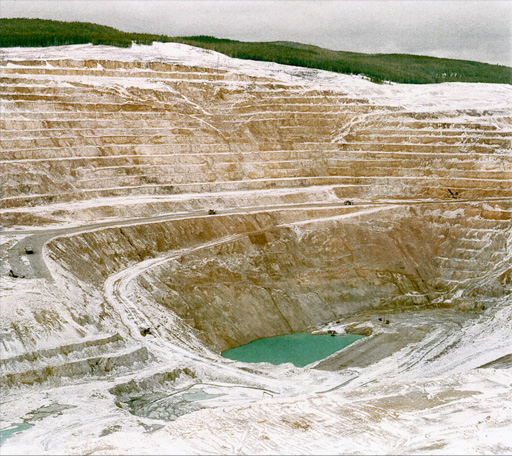
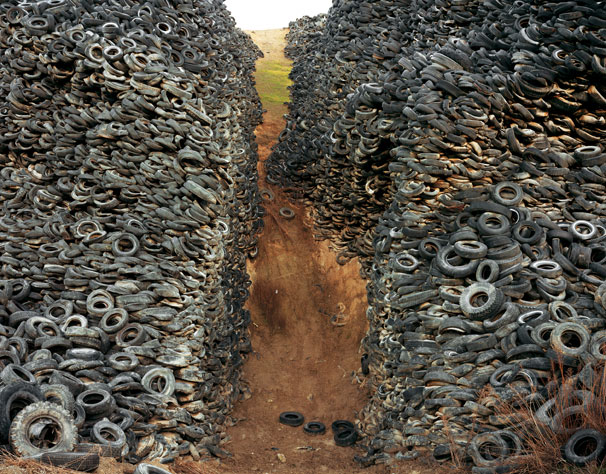
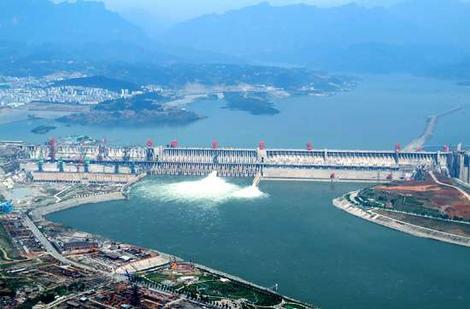
The picture on the top shows a neat landscape creation that catches peoples eyes, while the picture in the middle shows what waste is created from creating these landscapes. The bottom is a picture of the Three Gorges Damn.
Edward Burtynsky believes that we are all drawn to a good life. We all want a house and a car, but he also believes that there are boundaries. Recycling can already help reduce our footprint and new energy efficient technologies are continuously being developed. We just need to be more concerned over our ecological footprints and turn towards ways that reduce our footprints wherever possible that turn away from land destruction.
The need for energy and power ties in to the creation of oil and tar sands. The Alberta Oil Sands is one of the largest in the world next to Saudi Arabia. When I was reading about the Alberta Oil Sands on an Alberta government website they were saying that through responsible development and advancement of technology they could become the largest source of oil in the world (Government of Alberta, 2010 http://www.energy.alberta.ca/OurBusiness/oilsands.asp. ) Another example of humanity wanting power.
When thinking about the future that I would like to see for the Alberta Oil Sands Project I like to think in Edward Burtynsky’s view. Like Burtynsky I believe that we are all drawn to a good life and in that way I think the Alberta Oil Sands should continue supplying us with the energy we need. However, I also agree that we need to head towards more sustainable ideas and in that case I think the Oil Sands project could be reduced and replaced with alternate energies such as windmills. I think humanity should continue to head towards alternate energies that are safer to our environment. This includes setting up more plants that use wind power as a source of energy.
Over the last centuries there has been great changes to our environment and habitat from agriculture to urbanization. Physical changes to our habitat also effects the life within. For example, chemical changes in our atmosphere are causing the greenhouse effect which, is already influencing many changes in the polar regions such as buildings slumping from the melting permafrost and changing the migration patterns of some animals. Fragmentation and the roads being built through wildlife habitats are causing roadkill because the animals are reluctant to cross, which also causes barriers to movement and migration. Much of our land is being degraded from fragmentation, deforestation, agriculture, urbanization, climate change, etc. E.O. Wilson is fascinated by the Earth’s diversity of living organisms. He talks about how the degrading Earth will decrease the Earth’s biodiversity and the dangers we are in from loss of biodiversity (Follow this link to watch his video http://www.ted.com/talks/e_o_wilson_on_saving_life_on_earth.html ). He believes humanity needs to understand more about the importance of biodiversity and how we need all the organisms on the Earth. Every organism has a purpose as mentioned by Aldo Leopold (2009) in A Sand County Almanac, how the wolves control the deer population. We are constantly trying to wipe out all the insects because they tend to be pests for us, but without them we wouldn’t have much of our plants and food. Loss in biodiversity can include huge losses in potential sources of scientific information, much of environmental stability, new kinds of products, and spirituality.
We all impact wildlife either if it is indirect loss such as fragmentation and urbanization or direct loss such as hunting and fishing. Many national parks are set up to protect the wildlife from human impacts. Wapsuk is located by the coast of Hudson Bay and protects the polar bear by supplying one of the largest denning areas for the polar bear. However, national parks also causes more interaction between the humans and wild animals. I however, believe that national parks can meet its dual mandate of access and protection. Even though interaction often results as a bad thing for the animals I think the protection national parks can offer balances out to more of a benefit for the animals. The polar bear population has declined slightly and protection can be achieved in Wapsuk by having no hunting within this area, and signs up saying not to feed the bears which, will decrease the likelihood of the bears coming into the communities. Threats to the Canadian polar bears also includes the loss of habitat caused my mining, oil drilling, and other developments. Wapsuk national park offers a habitat for the bears that supplies them with their needs such as a home that includes ice and water (Parks Canada, 2010 http://www.pc.gc.ca/dci/src/3d_e.asp?what=more&sitename=wap&theme=sr&btn_state=HTML&more_lnk=no).

Location of Wapsuk National Park, Manitoba, Canada
Resources
Government of Alberta. (2010). Oil Sands. Retrieved February 18, 2010 from http:// www.energy.alberta.ca/OurBusiness/oilsands.asp
Flavin, C. & Dunn S. (2009). Reinventing the energy system. In T. Easton (Eds.) Environmental studies (3rd ed.) (pp. 70-75). New York, NY: The McGraw-Hill Companies.
Leopold, A. (2009). A sand county almanac. In T. Easton (Eds.) Environmental studies (3rd ed.) (pp. 10-12). New York, NY: The McGraw-Hill Companies.
Lovins, A.B. (2009). More profit with less carbon. In T. Easton (Eds.) Environmental studies (3rd ed.) (pp. 65-69). New York, NY: The McGraw-Hill Companies.
Parks Canada. (2010). The Wapsuk Polar Bear. Retrieved Feburary 23, 2010 from
http://www.pc.gc.ca/dci/src/3d_e.asp? what=more&sitename=wap&theme=sr&btn_state=HTML&more_lnk=no
Pinchot, G. (2010). Principles of conservation. In T. Easton (Eds.) Environmental studies (3rd ed.) (pp. 8-9). New York, NY: The McGraw-Hill Companies.
The Intergovernmental Panel on Climate Change. (2009). Climate change 2007: The physical science basis. In T. Easton (Eds.) Environmental studies (3rd ed.) (pp. 127-135). New York, NY: The McGraw-Hill Companies.
